
We left Baku early, heading north-west along the long road that once connected the Caspian to the interior. This route runs all the way to Balaken, tracing fragments of older trade paths, but for us it would end in Sheki. The distance mattered. The day was never going to be about one place.
Our first stop came after roughly 120 kilometres, in Shamakhi, at the Juma Mosque. Built in the eighth century, it is one of the oldest mosques in the country, though little about it feels frozen in time. Earthquakes, fire, neglect, and restoration have all left their marks. What stands today is layered — Shirvan-Absheron at its core, with later Persian, Seljuk, and Ottoman influences settling in around it.

Inside, the space feels open rather than ornate. The central dome rests quietly on arches and columns, calligraphy drawing the eye upward without insisting on attention. It was an unhurried stop — less about reverence than orientation — a reminder that this road had long connected belief, movement, and settlement.
Beyond Shamakhi, the landscape began to loosen. Fields opened out, the road stretched, and the sense of being between places became more pronounced. We travelled in a large Mercedes-Benz van — far bigger than the two of us required, but typical for private tours here — moving steadily through scenery that didn’t ask to be photographed, even if it often was.
By midday we reached Gabala, where the terrain shifts again. Mountains close in, forests thicken, and the air feels cooler. Just before the town, we stopped at Nohur Lake, a still body of water ringed by trees and overlooked by the surrounding Caucasus peaks. The lake is partly natural, partly engineered, but that distinction fades quickly once you’re standing there. The surface was calm, the reflections clean, and the stop brief — a pause rather than a destination.

From Gabala, we drove on to the Yeddi Gozel Waterfalls, set into thick greenery near the village of Vandam. Only the lower cascades are easily accessible; the rest require climbing and time we didn’t have. Water moved in steps rather than force, each level distinct, the sound constant. It was humid, enclosed, and quietly popular — a reminder that not all natural places offer solitude, and that this too is part of travel.

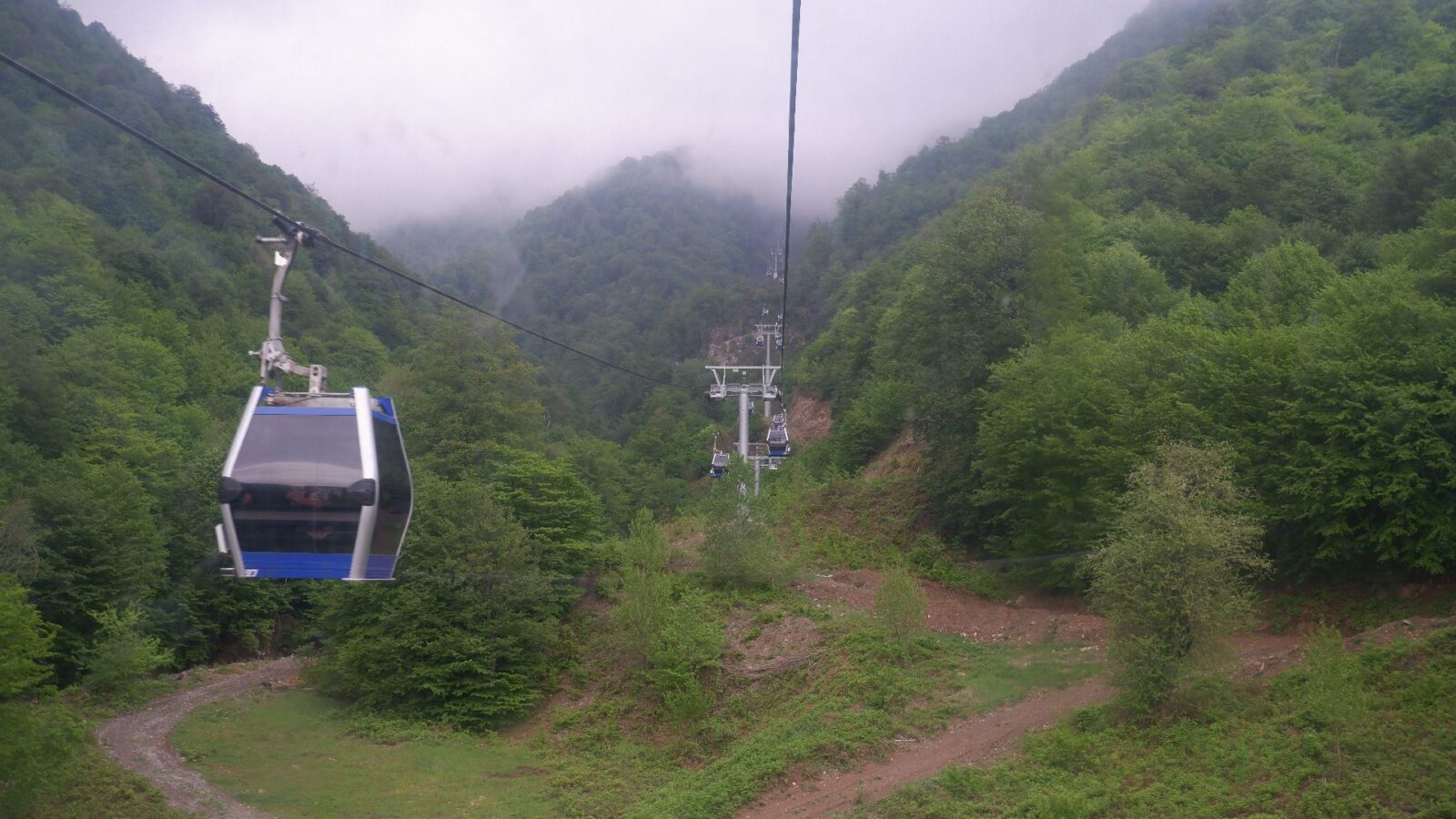
Later in the afternoon we reached Tufandag Resort, a place that feels almost deliberately at odds with the older rhythms of the road. Ski infrastructure dominates the slopes, but outside winter the focus shifts to the cable cars. Several ropeways were running, and we rode as many as we could.
Each ascent and descent altered perspective. One line climbed gently through forest, another rose more sharply, opening out onto long views across the valley. The final stretch dropped dramatically towards the river below — a steep descent that briefly emptied the cabin of conversation. These weren’t rides taken for thrill alone, but for scale — a way of seeing how the land folds and falls.
Lunch that day was unremarkable in the most honest sense. We ate at a restaurant serving Indian food, chosen less out of curiosity than convenience, the timing closer to lunner than lunch. It felt slightly out of place, but by then the day had already been shaped by movement rather than meals.
By evening, we continued on to Sheki. We stayed just one night, at a hotel overlooking the town, the light settling gently over rooftops and hills. It was not enough time, and it was obvious almost immediately. Some places ask for more than a stopover. Sheki was one of them.
Leave a Reply