
The Caucasus is often spoken of as a single region, but each country carries a very distinct character. Having already travelled through Azerbaijan and Georgia, Armenia felt like the natural third step — not to compare, but to complete the arc of the journey through Caucasia.
Armenia is landlocked, bordered by Georgia to the north, Turkey to the west, Azerbaijan to the east, and Iran to the south. Politics is never far from geography here. The long-running conflict between Armenia and Azerbaijan still shapes movement and perception, and even at the airport, travel histories are scrutinised more carefully than elsewhere in the region. We had applied for e-visas in advance, but questions about previous travel were routine and expected.
We took a morning flydubai flight to Yerevan and were driven straight from Zvartnots International Airport towards Dilijan, a little under a hundred kilometres away. As the city thinned out, the landscape changed steadily — flatter plains giving way to forests and softer light.
Dilijan sits within the Tavush Province, surrounded by thick woodland and rolling hills, and is often referred to as the “Switzerland of Armenia”. The comparison may be generous, but the town does feel removed — quieter, greener, and distinctly calmer than the capital.
We stayed at DilliJazz Hotel & Restaurant, located in Teghut village, a short drive from Dilijan town centre. Our room overlooked the forest, and a stream ran just behind the property, its sound constant and unforced. We had deliberately kept this first evening free, letting the journey settle before beginning our sightseeing.
Haghartsin Monastery
We began the next morning after breakfast — Armenia, outside Yerevan, tends to start its days later than we were used to. Restaurants open slowly, and mornings unfold without urgency.
Haghartsin Monastery lay directly on our route and became our first stop. Set deep within forested hills, the monastery appears almost as an extension of its surroundings rather than something imposed upon them. The quiet here felt earned.
Founded around the 10th century, Haghartsin grew into an important religious and cultural centre during the medieval period. Its main church, St. Astvatsatsin, dates to the 13th century and reflects a blend of Armenian architectural tradition with subtle Byzantine and Georgian influences. Intricate stone carvings and khachkars are scattered across the complex, some weathered, others carefully restored.
Like many Armenian monasteries, Haghartsin experienced cycles of prosperity, decline, and revival. Recent restoration has stabilised the structures without stripping away their sense of age. The result is a place that feels preserved, not polished.

Goshavank Monastery
From Haghartsin, we continued to Goshavank, located near the village of Gosh. Founded in the 12th century by the scholar and jurist Mkhitar Gosh, the monastery once functioned as an important educational centre alongside its religious role.
Goshavank is particularly known for its stonework — finely carved khachkars, sculptural details, and well-proportioned churches that reward slow observation. The Surb Astvatsatsin Church, with its central dome and surrounding gallery, anchors the complex. Inside, fragments of frescoes remain, muted but expressive.
Compared to Haghartsin, Goshavank felt more structured, more deliberate — less hidden, but no less contemplative.


Lake Parz
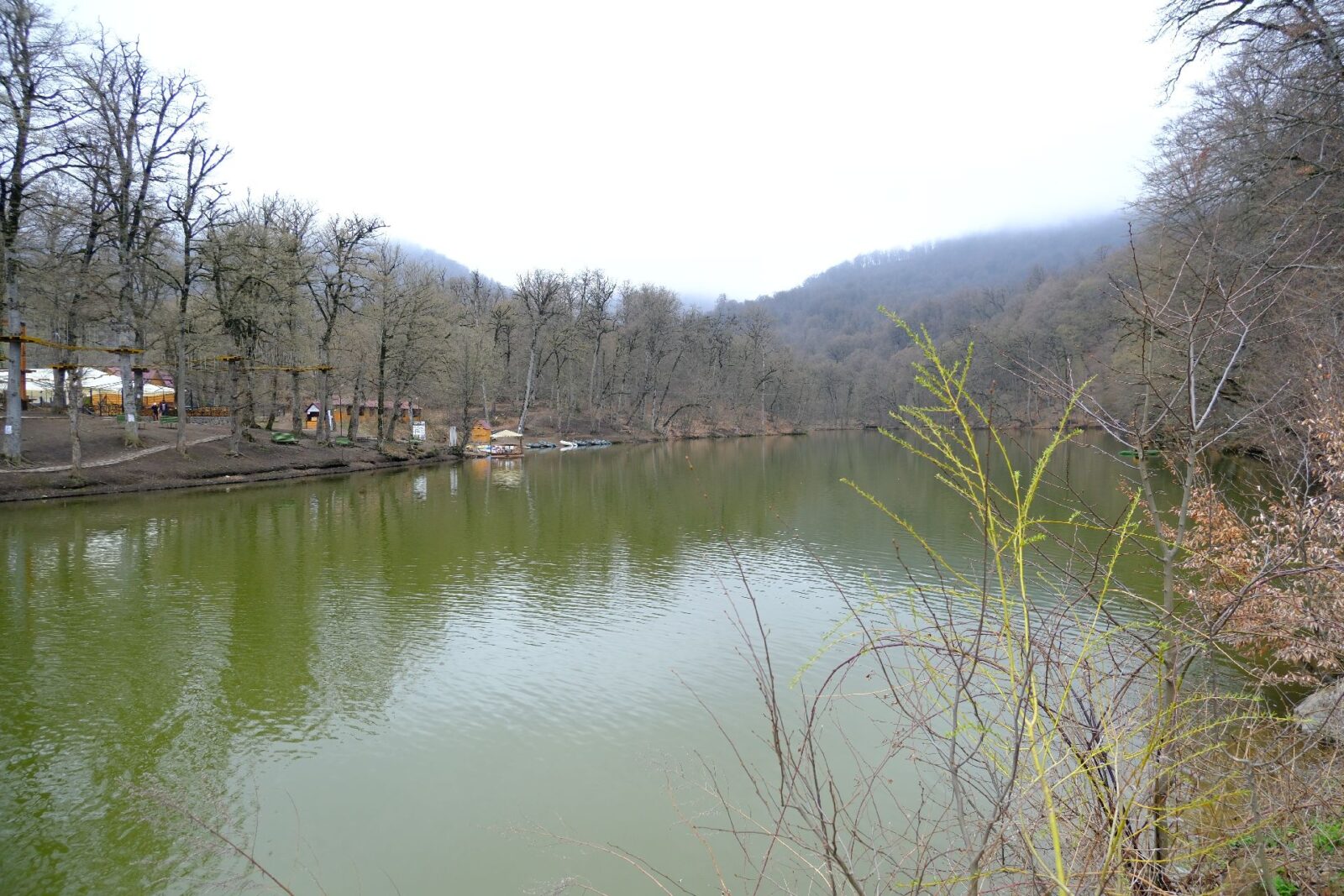
A short drive brought us to Lake Parz, tucked within Dilijan National Park. The name translates roughly to “clear” or “transparent”, though when we visited the water reflected the season more than the sky.
Surrounded by forested slopes, the lake felt like a pause rather than a destination — a place to walk briefly, breathe, and move on. Hiking trails branch out into the surrounding woods, and the area supports a variety of wildlife, including deer and bird species. There is also a nearby red deer breeding centre, though we did not visit it.
Dilijan Old Town
Back in Dilijan, we spent some time walking along Sharambeyan Street, the town’s restored old quarter. Lined with 19th-century buildings, wooden balconies, and small workshops, the street now hosts galleries, cafés, and craft shops.
It felt curated but not contrived — a gentle reworking of the town’s past rather than a reconstruction of it. We browsed quietly, picked up a few local items, and sat for a while without agenda.

Lake Sevan and Sevanavank
From Dilijan, we drove south towards Lake Sevan, Armenia’s vast high-altitude lake. Covering nearly a thousand square kilometres and sitting at around 1,900 metres above sea level, Sevan dominates the landscape long before you reach its shores.

Perched above the lake is Sevanavank Monastery, founded in the 9th century by Princess Mariam. The monastery’s two surviving churches — Surb Arakelots and Surb Astvatsatsin — are simple in form, built from dark volcanic stone. Their elevated position offers wide views across the water and the surrounding highlands.
The setting felt open and exposed, a contrast to the forested monasteries of Dilijan earlier in the day.

By evening, we continued on to Yerevan and checked into our hotel. We had arranged our sightseeing through Hyur Service, with each day treated as a separate tour. This meant different drivers on different days — efficient and punctual, though less personal than what we were used to from previous trips.
One exception was Arakel, who drove us south to Goris and stayed with us for two days. Despite his limited English, communication came easily through gestures, patience, and Google Translate — and his calm presence stayed with us. The day had moved steadily — forests to stone, hills to water, silence to city — without ever feeling rushed. Armenia had begun to reveal itself, not dramatically, but with quiet confidence.
Leave a Reply